

Cocoa Crunch in Cameroon: Falling Prices and EU ban hit Farmers
Last update: August 22, 2026
Disclaimer: This website may contain affiliate links, which means we may earn a commission if you click on the link and make a purchase. We only recommend products or services that we personally use and believe will add value to our readers. Your support is appreciated!
Imagine your income halving overnight, and then being told you need to pay to prove your farm hasn't cut down a single tree since 2020. That's the reality for cocoa farmers in Cameroon right now.
As reported by cbinews.tv, it's a proper double whammy - and people on the ground in Obala are feeling it.
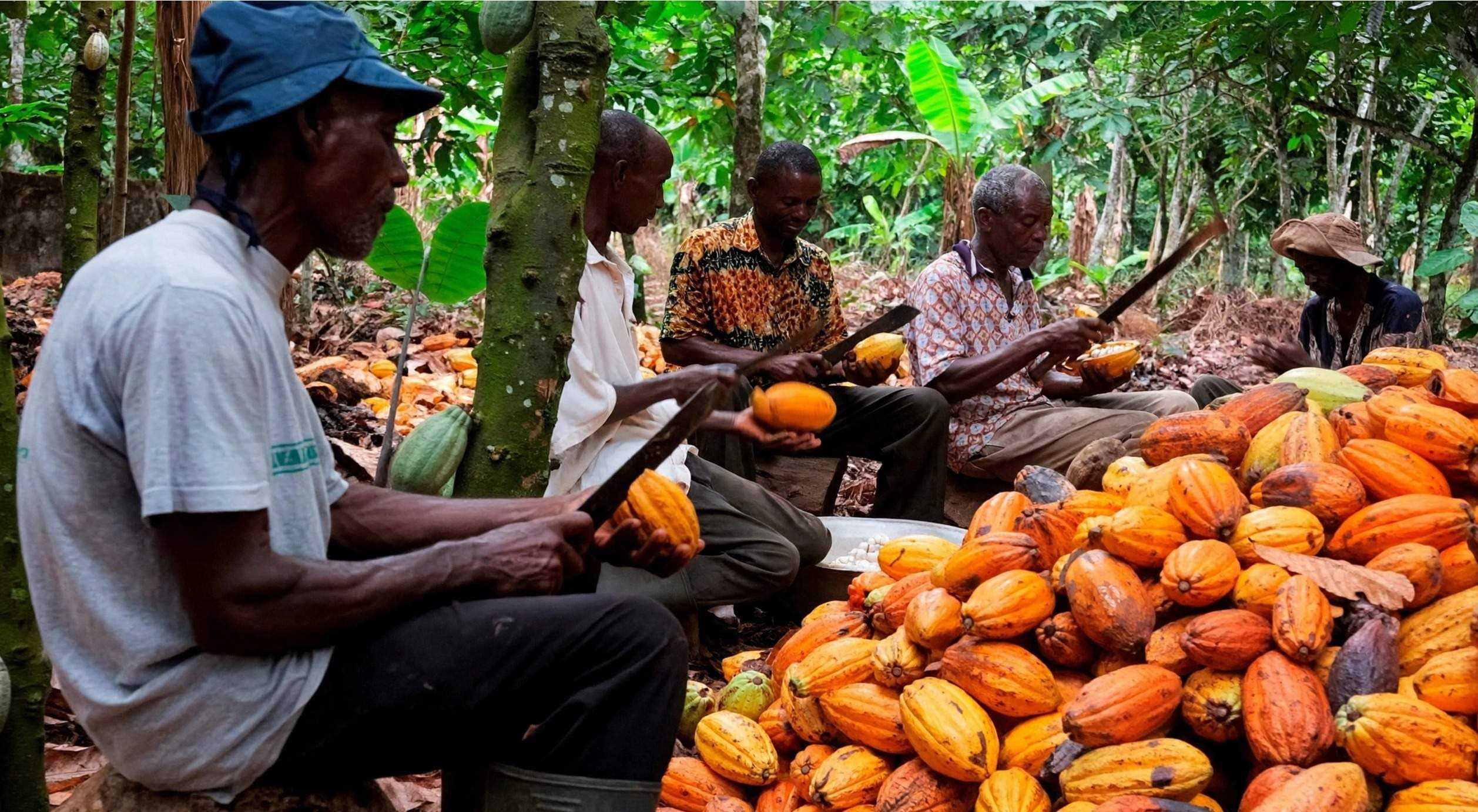
Footage filmed on Monday shows farmers doing what they've done for generations: harvesting the pods, cracking them open, laying the beans out to dry. Only this time, the maths just isn't mathsing.
“To our great surprise, cocoa prices plummeted,” said producer Tsala Francois Xavier. “We really don't know what to do.”
He's not exaggerating. And this is where the wider picture matters.
From boom to bust:
Remember 2024? Cocoa prices went absolutely bonkers. Thanks to drought and disease in Ivory Coast and Ghana, which together grow about 60% of the world's cocoa, prices topped $12,000 a tonne in December. For the first time, Cameroon's National Institute of Statistics said cocoa overtook crude oil as the country's top export earner - accounting for 26.3% of export revenue.
Fast forward a year and it's been brutal. Prices plunged by 48.1% in 2025 alone, sliding to around $6,056 a tonne by the end of the year. By January 2026 they were flirting with $5,000, and by 10 February they crashed below $4,000. As one report put it, it's back to a 20-month low after that record rally.
For a teacher-cum-farmer like Abraham Ekosse in Obala, that collapse is personal.
“It has greatly affected me, because I now make my living on this farm... I cannot pay my student school fees because of the drop in the price of cocoa,” he told cbinews.tv.
Then comes Brussels
Just as prices tanked, a huge new trade barrier looms.
The EU Deforestation Regulation, or EUDR, says any cocoa sold into the EU must be traceable and proven not to have come from land deforested after 31 December 2020. That means GPS mapping every plot, collecting polygon data, and full traceability from farm to port.
The rules were supposed to start in 2024, but after pushback from producer countries, they've been delayed - again. Large operators now have to comply from 30 December 2026, and micro and small enterprises get until 30 June 2027.
Why is this such a big deal for Cameroon? Because Europe IS the market. Official data shows 78% of Cameroon's cocoa exports and 87% of its coffee go to the EU. In the 2023/2024 season alone, Cameroon shipped 185,613 tonnes of beans to Europe, with the Netherlands buying over 70% of it. In 2023, Cameroon was the third-largest bulk cocoa exporter in the world at 211,000 tonnes.
Now farmers have to pay for the mapping tech.
“I cannot afford the cost of mapping farmland to meet traceability requirements,” Ekosse added.
And commercial director Mbida Jean Noel of Obala GIC said the regulation just doesn't fit how Cameroonians farm.
“When it comes to the farming operation, meaning no longer establishing cocoa in forest areas or in reserves, they don't understand.”
He's got a point. This is the historical twist.
Cameroon did it differently.
Unlike the vast full-sun monocultures in some West African neighbours that drove deforestation, Cameroon has a long tradition of agroforestry - growing cocoa under the shade of forest and fruit trees. The UN Food and Agriculture Organisation actually praises these systems for supporting biodiversity. The irony? That dense canopy makes satellite mapping a nightmare and plots harder to measure accurately.
As cocoa expert Simon Bassanaga told cbinews.tv:
“Cameroon actually deserves an incentive bonus... an environmental protection bonus, an environmental services premium. Cameroon is being penalised for what it did right, unlike the others.”
Cameroon is trying to adapt. The government, working with the EU and FAO, is building a national land-cover mapping and traceability system and is now preparing to share geolocation data to keep its EU market access. Export revenue from raw cocoa to the EU rose 18.6% in 2023 to CFA263.9 billion, so there's a lot to lose.
But for the smallholder in Obala with two hectares and no smartphone, the question is simple: who pays for compliance when the bean price has already collapsed?
That's the real BEANS war.
Original reporting by cbinews.tv
#Cameroon #CocoaCrisis #EUDR #EUDeforestationLaw #CocoaPrices #WestAfrica #Obala #ChocolateIndustry #Agroforestry #SustainableFarming #Trade #CommodityMarkets #FarmersFirst #CBINews